顯示具有 elearning 標籤的文章。 顯示所有文章

2013年9月11日 星期三

12 Reminders for Implementing e-School Bag

A "school bag" is very different from a general purpose bag. The former is a dedicated container for learning, especially when a student has a lot of physical items (e.g. textbooks, exercise books, handbook, pencil box, drawing tools, water bottle, lunch box, and many others)  in order to support his whole-day learning at school.

Digital school bag has the same idea. All you need for learning (except water and lunch box) could be digitized and contained in a light-weight mobile digital device, with a A4 size screen. iPads or other tablets immediately appear as the de facto devices for such concept.

In Hong Kong, not many schools converted themselves into such learning environment. Fortunately, we worked with 2 primary schools which embrace such e-Bag concept and turned it into reality some years before. These two schools are:
  1. The Hong Kong Institute of Education Jockey Club Primary School (JCPS)
  2. C&MA Chui Chak Lam Memorial School (CCL)


Why e-School Bag
  1. Real-time and 7x24 Multiple Feedback Loop - Learn from Others and Not Only from Teachers     
  2. Self-directed Learning - Fit One's Own Need and Pace
  3. Seamless Learning - Learning Everywhere  
  4. Early Adaptation to New Form of Economy - More Chance of Career Success
1. Eligibility

Students joining this e-Bag need to meet certain pre-requisites:
  1. Good academic results -Students need to get an average score of B for all subjects. 
  2. Self-discipline - Students need to follow instruction of teachers and behave themselves. 
  3.  Financially ready - Parents need to buy a school specified computer and bear the extra cost incurred.
e-Bag starts from primary 4. Once a student is accepted to e-Bag class in primary 4, he will be in e-Bag class for primary 5 and 6 as well.

2. Subject Coverage
The e-Bag programme is implemented as class-based. In the e-Bag classes, all major subjects will use digital way of teaching. The subjects include:
  1. Chinese
  2. English
  3. Math
  4. General Studies
  5. Visual Art
  6. Music 
Therefore, over 80% of class time will leverage e-School Bag for learning activities. This is very different from the on-demand approach of e-Learning in most schools, which only have digital devices to support few learning activities, accounting for less than 10% class time.

3. Teaching Content
Since both schools are public sector schools, they are following the local curriculum required by the Education Bureau. Most teaching contents are from major publishers ( http://www.publishersglobal.com/directory/hong-kong/subject/education-publishers/ )
Like other schools, teachers will create their own teaching materials according to their students' interests and capabilities. However, unlike other schools without e-Bag, teachers in such 2 schools could create new learning activities and dispatch information more efficiently, thanks to the digital devices for each student.

4. Any Printed Textbook?
With publishers' consent, textbooks are scanned and the digital copies are kept in students' dedicated learning device. With Dyknow (http://www.dyknow.com) as the classroom and learning support system, in theory, there is no need for printed textbook. However, parents are not as high-tech as their children and they explicitly request for printed textbooks. So that parents can easily do revision with their children, and, hence, less stress for them. Textbooks in such schools are not for students but for parents.

5. Parent Talks
More parent-school communication is needed since the e-Bag programme is a collaborative project by nature. Parents, students, and teachers need to tune in before they can dance together. There are 3 key parent events through out an academic year.
  • e-Bag Launch - In September, when students are just back to school, the e-Bag class will be trained to use their mobile learning device. This year, the two schools start using Lenovo Tablet2 for their primary 4 students. ( http://shopap.lenovo.com/hk/en/tablets/thinkpad/thinkpad-tablet-2/ ) This parent talk will brief them about the learning and teaching process at school using e-Bag, as well as advice for parents. 
  • e-Bag Open Class - In January, when students are adapted to e-Bag mode of learning, their parents will have a chance to see how their children learn at school. It is also serving as a promotion activity for next year's e-Bag programme. Parents of primary 3 students are invited to "feel" how such e-Bag creates value for their children. 
  • e-Bag Application Briefing - In June, it is almost the end of a school year. The school is going to recruit e-Bag students for next year. e-Bag a 3-year commitment starting from primary 4. Therefore, school will invite primary 3 students and their parents to "feel" and understand the programme details for next year.   

6. Involvement of Parent-Teacher-Association (PTA)
PTA support is crucial to e-Bag's success. At the beginning, PTA shows strong commitment on e-Bag by carrying out fund-raising activity, so that school could upgrade infrastructure and acquire other resources to start e-Bag programme. On-going communication through PTA is important. PTA helps managing parents' perception and addressing feedback on e-Bag, which are the keys to a win-win situation among parents, students, and the school.

In addition, PTA offers additional financial support to underprivileged students if they are accepted to e-Bag class. This gives a fair learning opportunity to all students in the schools.

7. Hardware
Students' end devices are the key equipment for learning. This year, the two schools start using Lenovo Tablet2 for their primary 4 students. ( http://shopap.lenovo.com/hk/en/tablets/thinkpad/thinkpad-tablet-2/ ) With close relationship with Lenovo, we could offer the two schools a very competitive price.

The two schools got a special requirement on maintenance which is a strong differentiator for us, namely Accident Damage Protection (ADP). (http://www.lenovo.com/services_warranty/US/en/accidental-damage-protection.html ) Within a year, there is a quota for unintentional damage not covered by basic warranty. Unintentional damage means liquid spills, unintentional drops and bumps.

A server was installed and configured in order to support a new classroom management system called Dyknow. (http://www.dyknow.com)

8. Software
A new classroom management system was required. Dyknow Vision was used to support classroom interaction.  (http://www.dyknow.com) Dyknow supports multiple platforms like Windows, Mac, Android, and iOS.

This tool could keep students engaged in learning activities and track their performance. This is a strong differentiator for the 2 schools in e-Learning and e-Teaching. This is the essential tool to integrate technology to teaching process. Without this tool being consistently used, it is hard to deliver extra benefits against traditional teaching approach.


9. School Infrastructure Upgrade
Network upgrade was performed before the e-Bag launch. This included the enhancement of network backbone, upgrade of network switch, installation of Wifi Access Point, etc. For the classrooms of e-Bag classes, renovation work was performed in order to install additional power plugs.

10. School Administration
This programme requires tweaking of school's class allocation system. Traditionally, students are allocated to different classes according to their academic performance. However, in e-Bag programme, students can apply for entering the e-Bag class. The traditional allocation system needs to give priority to e-Bag.  

11. Students Not in e-School Bag Programme
A typical e-Learning approach is adopted for non-e-Bag classes. Based on the learning and teaching activities in a subject, teachers may request student to bring a digital device (not limited to specific device) for a lesson or two.

12. Special Arrangement for Deprived Students
Underprivileged students are not deprived of the chance to enter e-Bag programme. Hong Kong Government offers help through the Internet Learning Support Programme ( http://www.gov.hk/tc/theme/ilearnathome/news/ ) and other financial aid through Student Financial Assistance (SFA) and Comprehensive Social Security Assistance (CSSA).

WebOrganic is offering additional financial assistance through WebOrganic Fund ( http://www.weborganic.hk/Pages/ch_wo_fund.aspx ). Successful applicants may receive computers and free Internet service for free.

Reference
  1. The Hong Kong Institute of Education Jockey Club Primary School (JCPS)
  2. C&MA Chui Chak Lam Memorial School (CCL)


2013年7月12日 星期五

Chiu Sheung School Parent Day (Jul 2013)

Background
My consulting team did an eLearning Pilot Project with Chiu Sheung School (CSS) in March 2013. (Reference: e-Learning Consulting - Reference Case of Chiu Sheung School - Fast-Tracking e-Learning Enablement Project ). It was a quite successful one. We even received a compliment letter from her Principal, Mr. Chim Hon Ming. We were invited to set up a booth to introduce our organization, WebOrganic, during the school's parent day on 12 July 2013.

Booth and School Hall Screen
Apart from setting up a booth at the school entrance, the school hall main projector screen was used to display our organization's introduction, our project videos, as well as some videos on the positive use of the Internet. We did receive greatest exposure to parents on such day. I deeply thanks CSS for their kindness and respect to our work.  


Delighting Parents
Knowing that parents may need to wait before meeting class teachers, we prepared a leaflet of QR code for killing time. There were 20 QR codes, arranged as 4 channels with different themes. At the back of the leaflet, it was the brief introduction of WebOrganic. 

The first channel was about the videos of our iPad e-Learning Pilot Project at CSS. The second channel is to get benefits from the Internet (e.g. using Taobao to save money) and avoid troubles (e.g. setting up agreement with children on Internet usage). Channel 3 is about eLearning projects we did for other schools. The last channel is in Cantonese which is about the positive use of the Internet (e.g. avoid Internet addition).

The feedback of the leaflet was quite good. All the printed copies were distributed out at around 10am. Since we just set up the playlist for videos created by other users, we cannot track how many parents watched such videos through our QR leaflet. Hope this will improve in the future.   

Display Board
There was one display board about eLearning. It was great that CSS formed a eLearning taskforce to promote eLearning, and she obtained resources to upgrade her wireless infrastructure as well as acquiring 30 iPad to start their eLearning journey. I believe we played an important part to accelerate the whole process. 


Special Remarks
Thanks for the Open Lesson at HKIEd Jockey Club Primary School (Ref: e-Learning Consulting - Open Lesson at Jockey Club Primary School ) early this year, which kicked start our conversation with CSS. 

Special thanks to Mr. Brian Tsang to make my wish came true. I wished to play basketball at school playground because I always saw students playing happily during their P.E. lessons. Finally I played basketball with Nic, Samson, and 7 non-Chinese-speaking (NCS) students from CSS. We also played volleyball and skateboard. Our sweat marked a beautiful full stop to the engagement with CSS this academic year. 


2013年6月28日 星期五

Reference Case of Shamshuipo Kaifong Welfare Association Primary School - Fast-Tracking e-Learning Enablement Project


Fast-Tracking e-Learning Enablement Project
Project Summary for Shamshuipo Kaifong Welfare Association Primary School

Background of Shamshuipo Kaifong Welfare Association Primary School (SSPKW)
SSPKW is an aided primary school established in 1964 and is located at 88 Yu Chau Street in Sham Shui Po. CSS has 8 classes in 6 class levels, with a total of 250 students. It is a relatively small school servicing students from it neighborhood, which has the largest number of poverty families in Hong Kong. 

Challenge Ahead
School was lack of resources to promote eLearning. Luckily, it received a donation in 2012 to acquire 40 iPads to start its eLearning journey. With hardware in place, SSPKW’s next challenge was to equip teachers with the skills to leverage such hardware, in order to improve her students’ learning results.


Leap Frog from Level 1 to Level 2++ within 4 Weeks
To have a quick jump, SSPKW engaged WebOrganic for a 4-week pilot project. After the project, Math teachers became confident in new ways of teaching. TA / TSS are trained to support mobile learning devices. School’s e-Learning roadmap was refined. The key outputs are: 
  1. A stable wireless e-Learning environment was setup at SSPKW for 2 weeks.
  2. 1 IT lesson and 3 Maths lessons were conducted using iPad, within a 2-week try-out period. Involved 3 teachers in a class level. 
  3. Seamlessly integrate lesson plans with 4 iPad apps through 2 co-plan and training sessions.
  4. A 3-year e-Learning roadmap was revised.
  5. 2 promotion video clips were created.


Roles of WebOrganic as an e-Learning Enabler and Accelerator 
  1. Teaching Consultant
    Conduct teacher training for using iPad as mobile learning device. Co-plan lessons with teachers to integrate iPad with T&L activities. Conduct a knowledge sharing session with all teaching staff.
  2. Strategy Consultant
    Identify learning trends and opportunities for school. Refine e-Learning roadmap with school and its key stakeholders.
  3. Project Manager
    Manage project scope, schedule, and resources. Report progress to stakeholders and resolve issues during project execution. 


About WebOrganic
  1. We are a not-for-profit social enterprise implementing government’s Internet Learning Support Programme (ILSP).
  2. We are a wholly owned subsidiary of Hong Kong Council of Social Service.
  3. We are giving hope, chance, and choice to our next generation.

2013年5月23日 星期四

發展電子學習的快車道分享會 (Fast-Track on e-Learning Development) - 後記


在2013年5月23日,我們在保良局王賜豪(田心谷)小學的圖書館舉行了一個給小學校長的電子學習分享會,主題為《發展電子學習的快車道》(Fast-Track on e-Learning Development)。這是後記。


早前,我們協助香港潮商學校實行了一個為期三個月的iPad電子學習試驗項目(iPad e-Learning Pilot Project)。因為這項目的效果非常之好,於是,我們被要求去安排這次分享會,請學校的校長和老師分享他們成功的電子教學經驗給其他小學校長。


原本的指示... Google Pizza Time (Social Gathering for Principals) 
原本的指示是在Google的銅鑼灣Office或附近的Cafe辦一個Social Gathering,邀請一些未接觸過的學校的校長們參加。藉著潮商學校的校長來作個誘因,然後用Google的同事來推銷一下與我們一起合辦的「香港數碼學堂」(Hong Kong Digital Academy ) YouTube頻道,之後就讓校長們自己互相Social一下。也讓老闆可以認識多一些校長,老闆說我們也可以為下一學年的School Programme鋪路。據聞Google可以Sponsor我們租場地。

最後...
跟一些老師試水後,發現Social Time for Principal係無老師可以Sell到校長來參加。我們急變陣,改為辦一個電子學習分享會,邀請潮商學校的校長和老師分享他們在項目實施過程中獲得的經驗,再在最後加一個自由分享環節。原本老闆話Google可以Sponsor我們租場地,但向Google一問之下是沒有的,但Air Time照樣要...有點被騙的感覺。好彩有田心谷小學的楊校長和周Sir,除了提供場地外,在各方面也很幫忙。


分享會當日
經過多返努力,最後成功找到另外九間學校的校長和老師。連同潮商,共十間小學、二十三人參加,其中七間更是有校長級的參加者,成績算是不俗。


總裁 Erwin 的開場白相當有分量,但使我們一開始就嚴重overrun。看來我下次要向大老闆再強調他可作開場白的時間。


潮商學校詹校長很欣賞我們的工作,落足力度推薦我們給其他學校。

曾Sir也很努力分享我為他預備的PowerPoint Slides,但似乎他並沒有rehearsal,平時他還是口齒伶俐,但今天...他似乎為未來留了很多進步空間...


Ms Wong 和 Ms Lam 在分享會中,大膽地做了次Edmodo的Live Demo。當時我真的替他們擔心...其實,我最初期望他們show screen capture的圖,所以有點surprise。勇氣可嘉!


在小組自由分享時間,Erwin只是坐在一張桌子前和伍校長傾談,我後悔沒有中途把他拉去見其他的校長,令這大龍鳳失去了很多的意義。幸好,從觀察所得,各校長和老師都很開心愉快地分享,應該獲益良多,滿載而歸。


特別多謝我的好助手Nic,他和我一起又愉快地完成了一項又大又難的工作。


2013年4月20日 星期六

推展電子學習的必備元素 - 電子學習分享會 (Apr 2013)

保良局王賜豪(田心谷)小學於2013年4月20日舉行了一個「創新光纖網絡及無線網絡技術分享會」。 

作為「有機上網」的計劃經理,很高興能成為當日的演講嘉賓之一。我的分享題目為「推展電子學習的必備元素」,主要分享在推行電子學習計劃中,容易被忽略的必要元素。


同日的分享嘉賓有三仁光學的Dr. Chan,銳捷的William分享,P2MT 的Dr. Lam分享。


2013年3月4日 星期一

Education Trends 2013


There are lots of authoritative persons and organizations talking about education trends and most will mention about e-Learning and e-Teaching. Here we focus on 10 trends on e-Learning and related pedagogy.

10 TRENDs: Change in learning dynamics - Learning happens any where, any time, any interaction, and any direction 

  1. Teacher-centric becomes student-centric (More focus on catering learner’s diversity)
  2. Single measurement becomes multi-dimensional assessment (Holistic assessment)
  3. Uni-directional (spoon-feeding) become bi-directional and multi-directional 
    • Student learns from other students (SS) 
    • Teacher learns from students (ST) ***
    • Parent learns from students (SP) ***
  4. Individual work becomes group collaboration (incl. cross-geographic)
  5. Inside school (class) becomes outside school (class) and cross-school (local & global)
  6. Learn during school time (using MMLC) becomes learn beyond school time (Using student’s own digital device)
  7. Structured and formal lesson design becomes exploratory (Question-based) and social-enabled  (Game-based) 
  8. Off-line (paper-based) becomes on-line (Internet/ Social media network)
  9. Knowledge is king becomes creativity is king
  10. Text-based becomes video-based


The presentation of this article is not very structured but aims at illustrating our point of view and serves as an input to teachers.

Reference

2013年3月1日 星期五

DSS eCurriculum Tour (Mar 2013)

My team was super busy with our first consulting project on e-Learning enablement in an aided primary school in March 2013. We got 1-day short notice that we have to go to an open day organized by Hong Kong Direct Subsidy Scheme Schools Council. We were requested to setup a booth in the event, although students from such schools are usually not our target audience. 

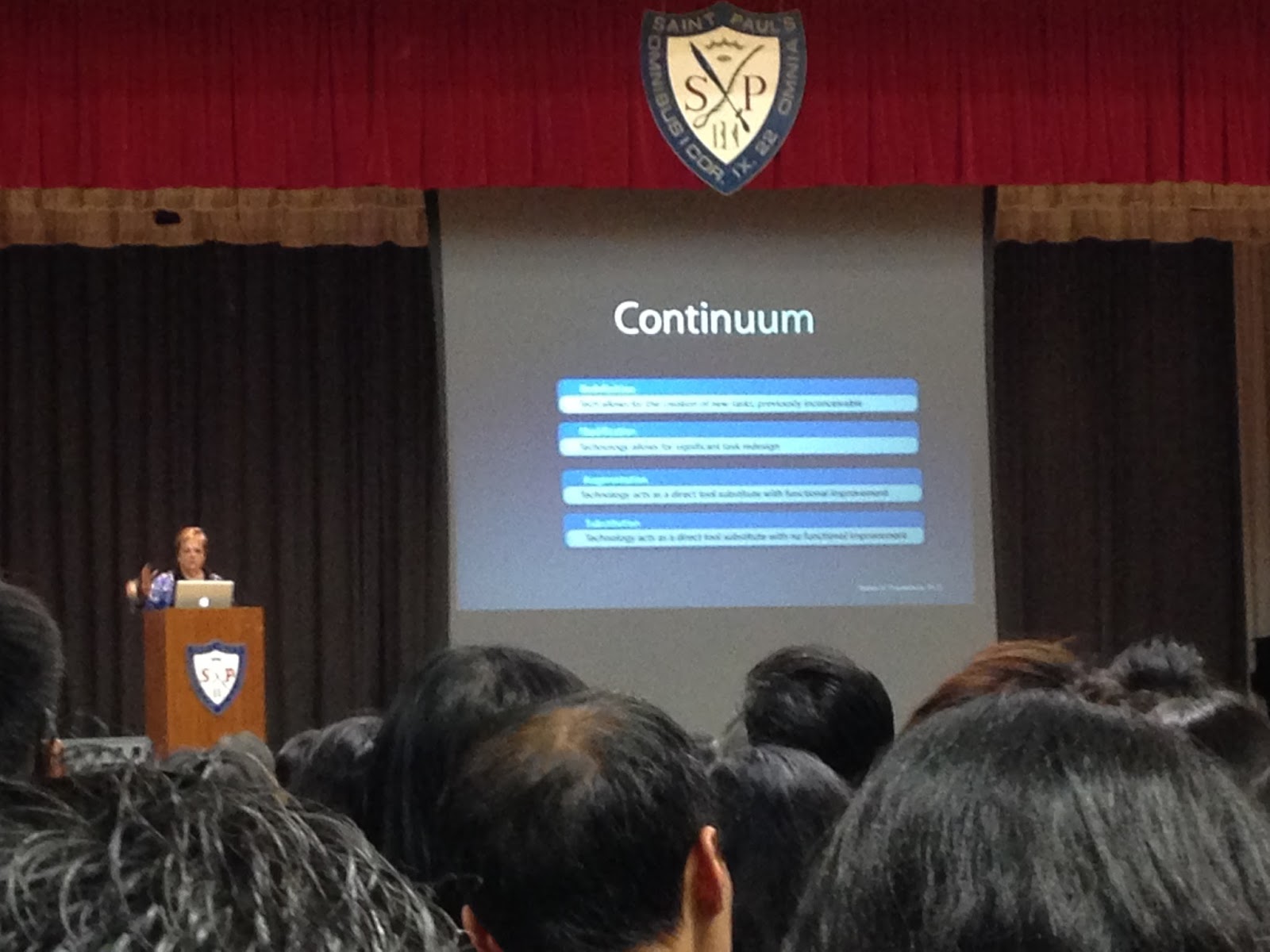
It was a well organized event hosted in St. Paul's Convent School. The programme run-down showed that an impressive number of 77 workshops and open lessons were conducted by a large number of DSS schools, with the use of advanced computing devices, like iPad. 


There were 6 key-note speeches delivered by renowned speakers, including Stephanie Hamilton, Sr. Manager from Apple's World Wide Education Strategic Initiatives Group. The school hall (with capacity of 1000+ seats) was fully filled with teachers and principals. 


Stephanie talked about different forms of pedagogical impact brought by new devices like iPad and their revolution to the world.   


Without pre-registration of the open lessons, we just walked in some of them according to the school and subject of the lessons. The lessons were very astonishing. Students seem to be very motivated and self-directed. It was a mixed mode of tertiary education and traditional secondary education.  


Before the DSS eCurriculum event, I was unhappy due to the short notice as well as the tremendous workload before and after the event. After the event, I was happy that I did not miss such a great show. This event accelerated my growth in the e-Learning domain. 

Thanks Hong Kong DSS Schools Council for such a great tour.  


2013年2月23日 星期六

eLearning Consortium ELC Education 2.9 Conference (Feb 2013)

On 23rd February, 2013, eLearning Consortium (eLC) held “Education 2.9 Conference-Next Step in e-Learning Revolution” in Cyber Port. Eddie Ng Hak-kim GBS, JP, the Secretary for Education, was invited as guest for opening speech. Our WebOrganic CEO, Mr.Erwin Huang, delivered the welcome remarks. 

The event was divided into four sessions, including “School Infrastructure Readiness”, “Content and System Readiness”, “Student and Parent Readiness” and “Teacher Readiness”.


I was one of the speakers on that day. My sharing topic was “Bicycle and Tricycle of e-Learning”, which included the role of parents during implementation e-Learning programmes, as well as parental support offered by WebOrganic.


It was my first time to have over 100 audience. I got short notice for this event as well. This time I got 3 days notice (not that bad) but was super busy with my first consultancy project in WebOrganic. Luckily, I had Nic to test out the contents with me. It was important to keep things simple and insightful.

 The speech was regarded as "Make or Break" my career, since it will be delivered to 100+ people and my CEO as well. I did rehearsed for a few times in order to achieve a smooth presentation flow.
Originally my speech was in the morning when even more audience was there. However, due to overrun by previous speakers, mine became the first after lunch. Good and bad... Good was that I got more time to rehearse; Bad was that I forgot a lot of my scripts in the morning (maybe because I was quite attentive to process what I heard from other speakers).

Overall speaking, this was a great experience for my career. Hope in one day, I will deliver a speech in front of a million people.


The seminar speakers are listed below:

  • Mr. Charles Mok , Legislative Councilor – (IT);
  • Ms. Winnie Wong, Head of Marketing, HK Cyberport Management Company Limited;
  • Ms. Leona Wong, Executive Director, HK Wireless Technology Industry Association (WTIA); Mr. She Mang, Chief Curriculum Development Officer, IT in Education;
  • Mr. Victor Cheng, Executive Director, Hong Kong Education City;
  • Mr. Ip Kin Yuen Legislative Councilor – (Education Constituency);
  • Dr. Allen Wong, SVP, Product Development and Management, Consumer Group, HKT Education Limited;
  • Mr. Li Chi Shing (IT Panel); Po Leung Kuk, Chee Jing Yin Primary School, (won in 2012 Chief Executive's Award for Excellence in Education (information Technology in Education); Ms. Becky Lo, Education Lead, Public Sector Group, Microsoft Hong Kong Limited;
  • Ms. Deon Man, Baptist Lui Ming Choi (Shatin Wai) Primary School; Cheung Kwok Che, Legislative Councilor (Social Welfare);
  • Mr. Jeff Ng, Programme Manager, WebOrganic;
  • Mr. Ha Chi Hung, IT Panel, True Light Middle School of HK, the Hong Kong Institute of Education;
  • Dr. Kong Siu Cheung, Head of Department of Mathematics and Information Technology, Hong Kong Institute of Education the Hong Kong Institute of Education Jockey Club;
  • Mr. Chu Tsz Wing, The HKIEd Jockey Club Primary School;
  • Mr. Jimmy Lam, Head of Information Technology Department;
  • Mr. Andy Li, IT Panel, Salesian School;
  • Mr. Wong Kin Wai, Albert, Chairman of Association of IT Leaders in Education (AiTLE)


For more information, please visit ELC's website: http://elearning.org.hk/

2013年2月5日 星期二

Open e-Learning Lesson at The Lok Sin Tong Leung Wong Wai Fong Memorial School 樂善堂梁黃蕙芳紀念學校 (Feb 2013)


On 5th Feb 2013, I attended an open lesson at The Lok Sin Tong Leung Wong Wai Fong Memorial School (樂善堂梁黃蕙芳紀念學校). This was co-organized by the school and e-Class which was an education solution vendor. 


For evey open lesson, it is like a show. Usually teachers will select more mature students from P.4 or above. But for this lesson, Mr. Tang, the demonstrator, was so confident and chose a P.2 class for demonstration purpose. The lesson was on Math and the topic was about multiplication.


Lesson was quite smooth. Mr. Tang used the digital whiteboard a lot. Whenever Mr. Tang asked a question, students raised their hands quickly to show that they knew the answer.


The lesson was conducted for more than 30 minutes and , finally, iPad got into the demonstration in a T&L activity. A paid apps, Math Runner, was used for game-based learning. Two students used one iPad and played the game in "1 vs 1" battle mode. The iPad was also used for consolidation. A PowerLesson quiz was setup to test the students' understanding of the topic. Feedback of the lesson was collected through the PowerLesson platform. Interactive statistical report was immediately generated and Mr. Tang was able to drill down to individual response.

Indeed this was a good demo on how to integrate a Learning Management System (LMS), digital whiteboard, iPad, traditional printed textbook, and learning analytics in a lesson. I observed that e-Class devoted a lot of resources to support this school. In this event, there were over 10 staff from e-Class to support it. 

After the event, I met Mr. Wong, the IT Panel of this school. He was a really helpful and humble person. The relationship between WebOrganic and Mr. Wong was quite strong and there were quite a lot of interactions since our school programme launched in 2011.

I also met some co-workers from e-Class. I found that John Chan, a senior manager from e-Class, was a brother in Christ from my church. Our sons played together in the same room at church. 

Apart from e-Class, there are many LMS solutions in the market, like i-Class from a group of HKU students, Edmodo from Silicon Valley with 15 million users, etc. This event accelerated my understanding of the local market landscape for LMS. 

To conclude, the e-Class PowerLesson solution was quite user-friendly and mature. The open lesson demonstrated not only the LMS but also how it integrated into every day lesson. It was a good show!!!

2013年1月12日 星期六

Open e-Learning Lesson at Jockey Club Primary School (Jan 2013)

On 12th Jan 2013, I attended an open lesson at The Hong Kong Institute Of Education Jockey Club Primary School (JCPS). This was the first parent event for JCPS in academic year 2012/13. This event was sponsored by Microsoft and got some media exposure.


Mr. Chu Tsz Wing (Chu Sir) was the teacher-in-charge of the event. He was a star teacher in local primary education and a Microsoft Valued Teacher (MVT). Chu Sir was a friend of our CEO, Erwin Wang, and he reserved a booth for us. 


On that day, I just joined WebOrganic for a month. Due to the short notice before the event, things were not perfectly-prepared. Nic and I could only leverage existing materials on hand. We brought some colorful marketing materials in order to cover the whole booth. Luckily the effect was quite impressive and we attracted good traffic to our booth. 


There were over 100 parents attending the open lesson. Most of them were parents of the P.4C class, which was the prestigious e-School bag (e-Bag) class. Students applied to join such class when they were in primary three. They needed to have good average grade for all subjects and be self-disciplined. This was like a social status for the smart students.


P.4C parents wanted to know how their students use the e-Bag for learning. Some participants were parents of JCPS's primary three students, and they would like to know more about e-Bag project. This was a carefully-crafted event to prepare the pipeline for next year's e-Bag project. 


e-Bag was more than exclusive right for bringing a learning device to school. Instead, this was associated to a shift in pedagogy (teaching methodology). Primary school students started acquiring knowledge and skills according to their own pace (student-centric) through discussion, collaboration, problem solving, and creative inquiry. 


In the open lesson, team work and collaboration were crystal clear. It was an English lesson taught by Ms. Koo. Each team distributed their tasks and finally merged each piece of their teammate's work. Students helped their teammates resolve problems that affect the team's overall progress. Originally, they are a team of best. At that moment, they are becoming a best team. 


From Chu Sir's wrap-up presentation, he cited the 21 Century Skills and PISA figures. It was really impressive and I got answers to my many questions in e-Learning, especially for the latest situations of some leading schools. 

The pace of e-Learning has reached a speed that most parents can never catch up. Being a parent, parenting is increasingly challenging. How could we lead our children when they run so fast even in primary school stage? This area touched the limitation of many teachers and I believe society has an urgency to educate parents to become competent parents in new digital era. We need a culture that could make most parents successful in parenting.